Every week,聽快猫视频 seeks to understand how people move the Naira in and out of their lives. Some stories will be struggle-ish, others will be bougie. All the time, it鈥檒l be revealing.
What is your earliest memory of money?
When I was about five or six years old, my parents had just separated, and I was living with my mother.
I remember her coming home with crisp stacks of 鈧�200 notes. It was a big deal because the 鈧�200 denomination had just been released. That was my very first memory of money, but the most impactful one happened when I was 9.
My mum randomly announced that my sister and I had to start taking public transport to and from school. Before then, we took the school bus or went with friends. My mum explained that, since she only had one car, she had to drive to work and simply couldn’t afford a driver or the school bus.
My mum was raising three kids by herself, but up until then, I never felt we were lacking anything. It was the first time I realised that you need money in life.
Do you remember what life was like before your parents separated?
They separated when I was five years old, so I don鈥檛 remember much, but I know we had a few more things.
I have pictures of my summer vacations abroad, and I imagine we lived better, but I really didn鈥檛 feel much of a difference. My dad was a businessman and had more money than my mum, who was a civil servant.
My mum was incredible, though. She sheltered us and made sure we never suffered. We wore great clothes, had toys, and packed lunches for school. When she travelled for work, she would take catalogues from different stores and ask us to circle the things we wanted. Then she鈥檇 buy them. I don鈥檛 know how she managed to provide for us, but she did.
Things changed again when I was 10.
What happened?
My siblings and I went to live with my dad. I didn鈥檛 know why at the time, but apparently, he argued that he would give us a better education. My mum was facing civil service housing restructuring and couldn鈥檛 get subsidised housing, so she agreed. One holiday, we went to visit him, and we just never moved back.
Financially, it was a massive upward shift. We moved from a semi-government missionary school to an elite private school in Lagos with an American curriculum. My peers were the children of governors, politicians, and captains of industry. They were definitely more 鈥渁jebutter鈥� than I was.
My dad was rich, but he ensured we did our chores and ran errands. Many of my classmates didn’t even know how to take an okada or go to the market to blend pepper. The exposure I got from living with my dad, coupled with noticing how sheltered my classmates were, led me to the first thing I did for money in secondary school.
Tell me about it
My friend and I bought packs of gum and sweets to resell in school. In the market, a piece could cost 鈧�5, and we鈥檇 sell it for 鈧�20 or 鈧�30. The profit margins were insane. My classmates had no idea since they didn鈥檛 even know the actual price.
Interestingly, I didn’t need the money. I got a weekly allowance plus school lunch, so my friend and I spent the extra cash on stuff like lip gloss, CDs and imported snacks. We did this 鈥渂usiness鈥� on and off throughout secondary school. It was lowkey, though; the school frowned on it.
I graduated from secondary school in 2011 and moved to the Middle East for university.
What was life at uni like?
Some of my half-siblings were already in the country, so settling in wasn鈥檛 difficult. My dad paid my tuition, and my stepmum stocked us up on dry goods and groceries at the start of every semester. My monthly pocket money was about 鈧�40,000 (after conversion from the local currency), which was enough, since everything else was covered.
However, though I didn’t need to work, I tried my hand at a wild number of hustles in uni. The first one was in my second year when I had a stint selling fabrics.
How did that happen?
We were planning a cultural show at the university, and the African students were looking for traditional textiles. I knew the big markets because I鈥檇 visited them once with my mum. So, I found a dealer who sold Ankara and lace, made bulk purchases, and resold them to other students at a markup.
Around the same time, I started mixing my own body butters and soaps. My skin looked great, people noticed, and I turned it into a small dorm-room business, making about $140 a month. I did that on and off in my second year.
Not bad
I didn鈥檛 stop there. I also got heavily into wigs and hair extensions. I watched YouTubers buy hair directly from China via AliExpress. I ordered some, coloured it and made a custom unit for myself. An Ethiopian girl on campus loved it and asked if I could do her sew-in weave. I had never done one in my life, but I knew how to sew. It took me six hours, but it came out beautifully.
Soon, I was charging around $30 per style for weaves and crochet hair. I also started selling high-quality human hair extensions. I would source the hair for $200 and sell it to them for $450 to $500. I did that throughout my time in uni, and even for some time after.
罢丑别听聽is returning on August 22, 2026, in Lagos! Come learn from finance experts and industry leaders, and partake in unfiltered conversations about building wealth and diversifying your income stream in a country like Nigeria.聽Real stories, expert advice you can actually use, and a community ready to build wealth together.聽.
It sounds like you were flush with cash
I was working multiple angles. In my final year, I dropped my course load to three classes per semester and picked up two on-campus jobs, earning an extra $330 per month.
I even took an unpaid off-campus editorial role at an international magazine, trying to position myself for a corporate path after switching from a technical major to a social sciences major.
I went hard because I desperately wanted to ensure that when I graduated, I wouldn’t have to look to my parents for financial support.
I get it. When did you graduate?
2016. I landed a graduate trainee role at an insurance company about a month after. My salary was equivalent to $1,200/month. I didn鈥檛 pay rent because I lived with my sister, so it was enough for transport, groceries, and going out. But I only stayed at the job for three months.
Why only three months?
There were four trainees: two guys and two girls. A male peer and I were the top performers. When it came time to offer full-time positions, management approached him first with a low offer, which he rejected to pursue his master’s degree.
A week later, they offered me the role at an even lower salary. I felt completely insulted and quit on the spot. It was a terrible financial decision in hindsight. I ended up without a stable, full-time job for nearly three years.
How did you survive those three years?
I entered the freelance trenches. I picked up photography skills from my campus job and started shooting weddings, portraits, and events. I charged about $200 per hour. Some months, I made $800 to $1,000. In one exceptional month, I made $8,000 because I shot gigs back-to-back. I also did some border-buying, shipping fabrics to a friend who ran a fashion line in the US. I did a lot of odd jobs, really.
In late 2017, my sister woke me up one morning and told me, “You have to start paying your half of the rent.”
Our rent was about $1,000 a month. It was the tough love I needed. I pivoted to social media consulting for brands and restaurants to secure repeatable, monthly retainers. In early 2018, my sister and I launched a social media consultancy.
Did the agency stabilise things?
It was going well until clients started defaulting on payments. At one point, we were being owed about $11,000. Entrepreneurship is truly the ghetto. Then, in mid-2018, my dad passed away.
I鈥檓 so sorry for your loss
Thank you. I was grieving, exhausted, and emotionally drained. I was already in Nigeria when he passed, and I figured I could just stay here and live in his house rent-free.
So, after the burial, I temporarily returned abroad to officially wrap up the agency with my sister, and then in August 2018, I moved back to Lagos.
What was the transition back to Lagos like?
It felt like a soft landing initially. My stepmum and family got me a car. They also wanted me to work at the family printing factory, but I refused. I was a creative marketing person; I couldn’t picture myself working in a factory.
Social media marketing was booming, so I went on Twitter, found an opening, went through a few interviews, and got a job by October. The salary was 鈧�150k/month.
I quickly realised that 鈧�150k in Lagos was hardly enough for anything. Before my car was fully sorted, I was spending 鈧�5,000 per trip on cab rides from the mainland to the island, which drained my finances. Even without paying rent, my salary evaporated 鈥� a full tank of fuel was roughly 鈧�8,000 a week.
I was still trying to shop on ASOS and go out for brunch with my international mindset, and I was actively dipping into the $5,000 savings I brought back from the Middle East.
By December, I went to my family’s company and pitched a remote marketing strategy role to help them expand a product. They agreed and paid me an additional 鈧�150k. Now I was making 鈧�300k/month, but it still wasn’t cutting it. I wanted my own apartment, and Lagos was aggressively draining my mental health. I hated waking up at 5 a.m., battling traffic, and sleeping in my car before the office opened. On top of that, political shifts in 2019 made me feel like I was wasting my life.
Because of my residency status in the Middle East, I had to return to the country every six months to keep my visa active. In March 2019, completely fed up with Lagos wahala, I bought a one-way ticket and flew back to the Middle East with no concrete plan.
You japada鈥檇
Yes. I squatted with a friend for two months until my sister’s lease ended and we could get a place together again. I jumped back into freelance photography and social media consulting until July 2019, when I landed a full-time marketing manager role at a high-end jewellery startup.
They paid me about $2,700/month. My benefits didn’t include health insurance, but the workplace was flexible, and it was a livable wage. I figured I could finally scale my corporate career across multiple markets.
Then 2020 and COVID-19 hit.
That doesn鈥檛 sound good
The startup relied heavily on luxury, in-person events. We didn’t have an e-commerce website when the lockdowns happened, so we completely missed the online shopping wave. My salary was cut down by 20%.
To pivot, I launched an international e-commerce coaching business in May 2020. I landed three long-term clients in the UK, Australia, and New Zealand, charging them $300 a month to manage their Shopify stores and emails. By August 2020, that had become my primary source of income because the jewellery startup had folded.
I spent most of 2021 freelancing, managing Shopify stores, and handling product photography for restaurants and beauty brands. I was averaging at least $2,700/month, sometimes hitting $4,000. But the inconsistent income gave me severe anxiety. I wanted a predictable corporate routine where I could just focus on one thing.
In August 2021, a beauty founder hired me to launch a short-term campaign. We got along so well that she threw me an incredible opportunity: a recommendation for a six-month project management contract for an international exhibition.
Love it. What was the pay like?
The client was from Nigeria, so they paid me a flat 鈧�8 million. The project was fantastic. It gave me on-site staff accommodation, a massive CV boost, and the opportunity to network globally.
I still kept my freelance retainers on the side, too. In December, I photographed a single weekend event and was paid $2000 for a day and a half’s work. I felt like I was finally on the right path.
Then, right after Boxing Day, I fell ill. I spent five days in the hospital, unable to even open my eyes without experiencing severe nausea. Because of visa bans on Nigerians at the time, I couldn’t even tell my mother or stepmum, since they wouldn’t have been able to fly in to see me.
Lying in that hospital bed, terrified, I had an epiphany: I absolutely cannot die in a foreign country. My apartment lease was up in May 2023, so I packed up my life and moved back to Nigeria for good.
What did you do when you landed back in Nigeria?
I went right back into freelance consulting and media production, but the financial instability returned. I billed a company 鈧�2.5 million/month for a marketing consulting gig, but they only paid me for two months and stiffed me on the rest. I did production projects that brought in between 鈧�1.5 million and 鈧�3 million, but the gaps between checks were too wide.
By April 2025, I was effectively broke. I was living on my own, and inflation was aggressively wiping out the value of money. I remember going to Abuja for a corporate pitch with a communications agency and hearing people tossing around figures in the hundreds of millions. While I was there, with literally only 鈧�20k left to my name because clients hadn’t cleared my invoices, and I鈥檇 just paid for a 10-day vacation to Kenya.
I told myself my life had to change. I had extensive international experience across Europe, the Middle East, and Africa; I needed to stop chasing local gigs and instead target structured corporate roles that are open to remote African professionals. I went on vacation to clear my head, returned home and went hard on job applications.
In June 2025, I landed my current full-time job.
I rate the energy. What鈥檚 your current role?
I am an operations manager at an international civic research and intelligence firm.
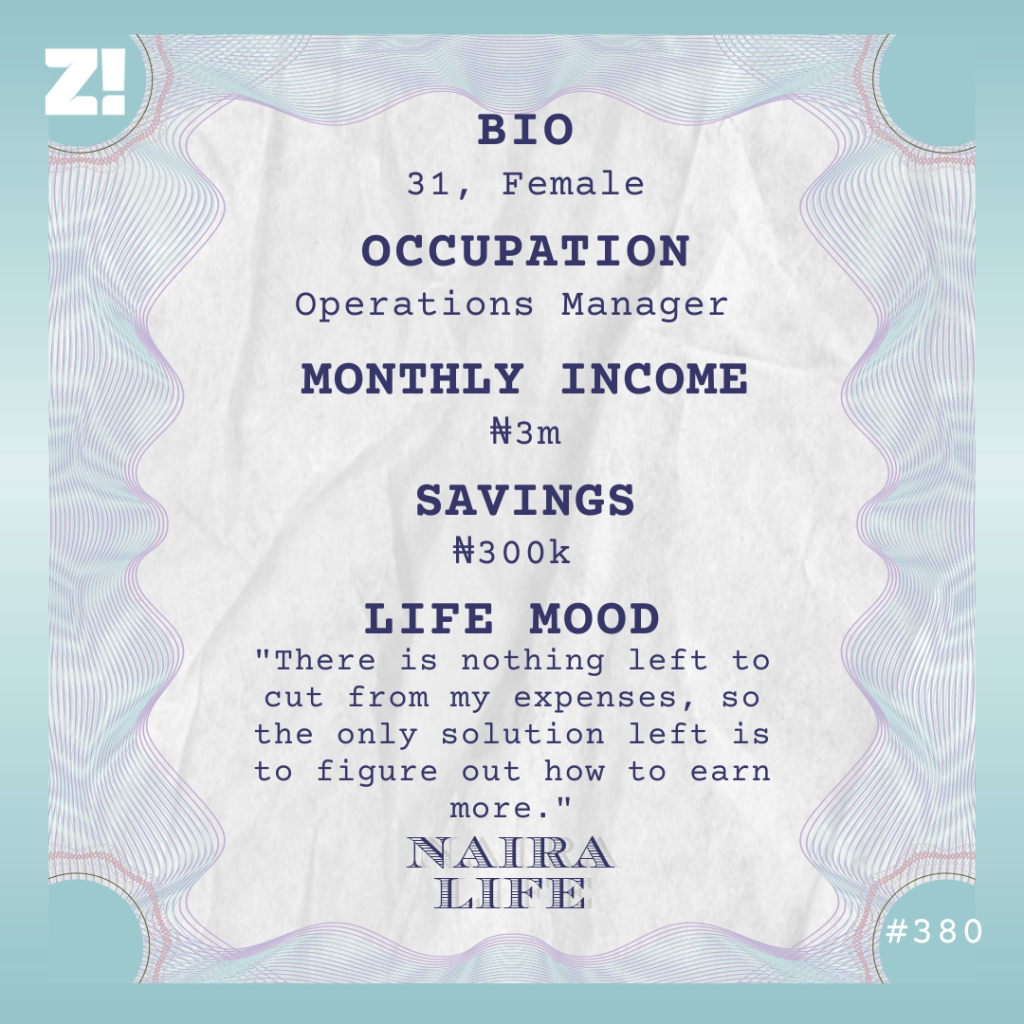
When I first started in July last year, my take-home pay was roughly 鈧�2.6 million net. There was a recent salary adjustment, and I now earn a little over 鈧�3 million net a month. It is a fully remote 9-to-5 position, and I have completely stopped taking outside consulting. I鈥檓 simply too exhausted.
What kind of lifestyle does 鈧�3 million a month afford you?
It honestly doesn’t afford me the flexibility you would think. I am incredibly grateful for the role, especially because the corporate health insurance is so comprehensive that it fully covered 鈧�6 million in medical treatments for my ongoing health issues this past year.
But even though I earn significantly more than the average person, I feel a distinct lack of disposable income. I share a large house and split the 鈧�5 million annual rent with my sister, which heavily subsidises my costs, but the baseline expense of just existing in Nigeria right now is staggering.
I dumped my bank statements into an AI tool this past April because I was tired of feeling broke before payday. My fixed lifestyle costs eat up nearly 鈧�900,000 a month before I even buy groceries.
Can you break down your monthly expenses?
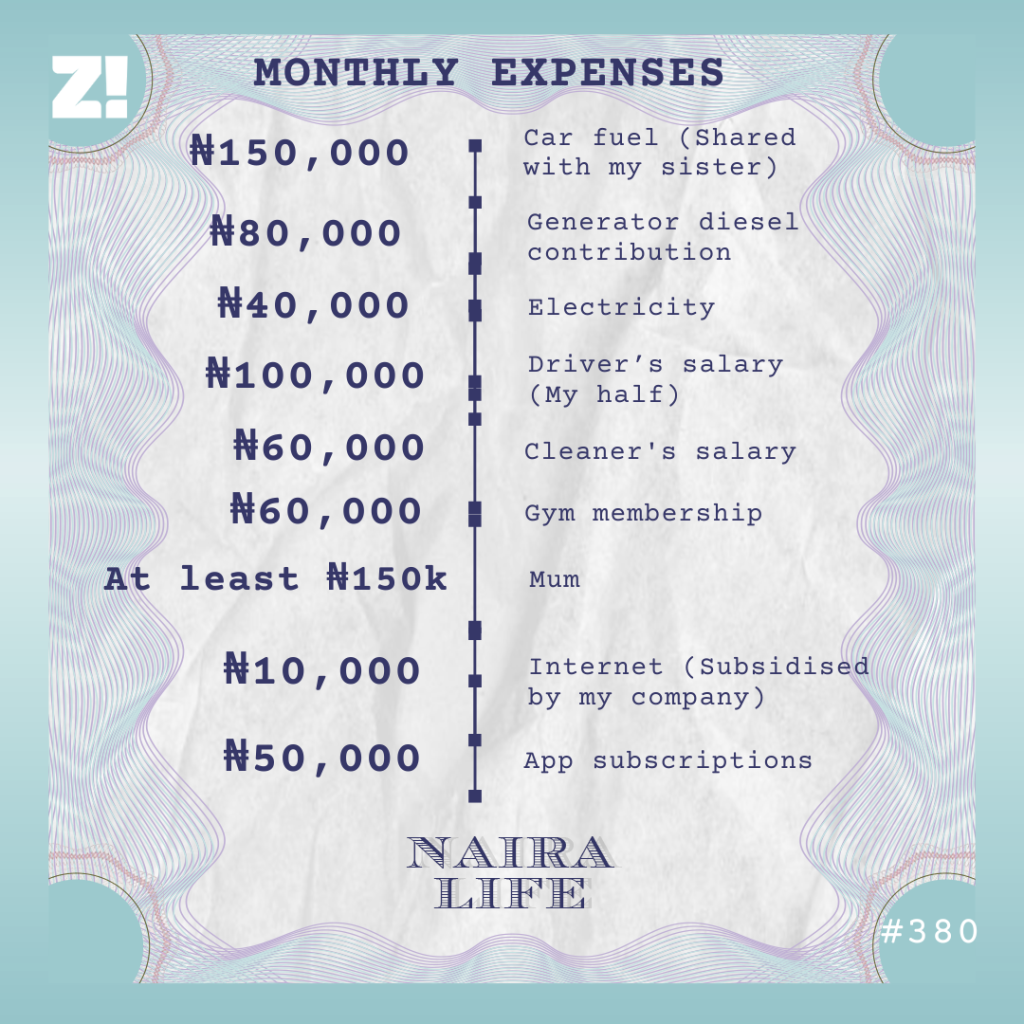
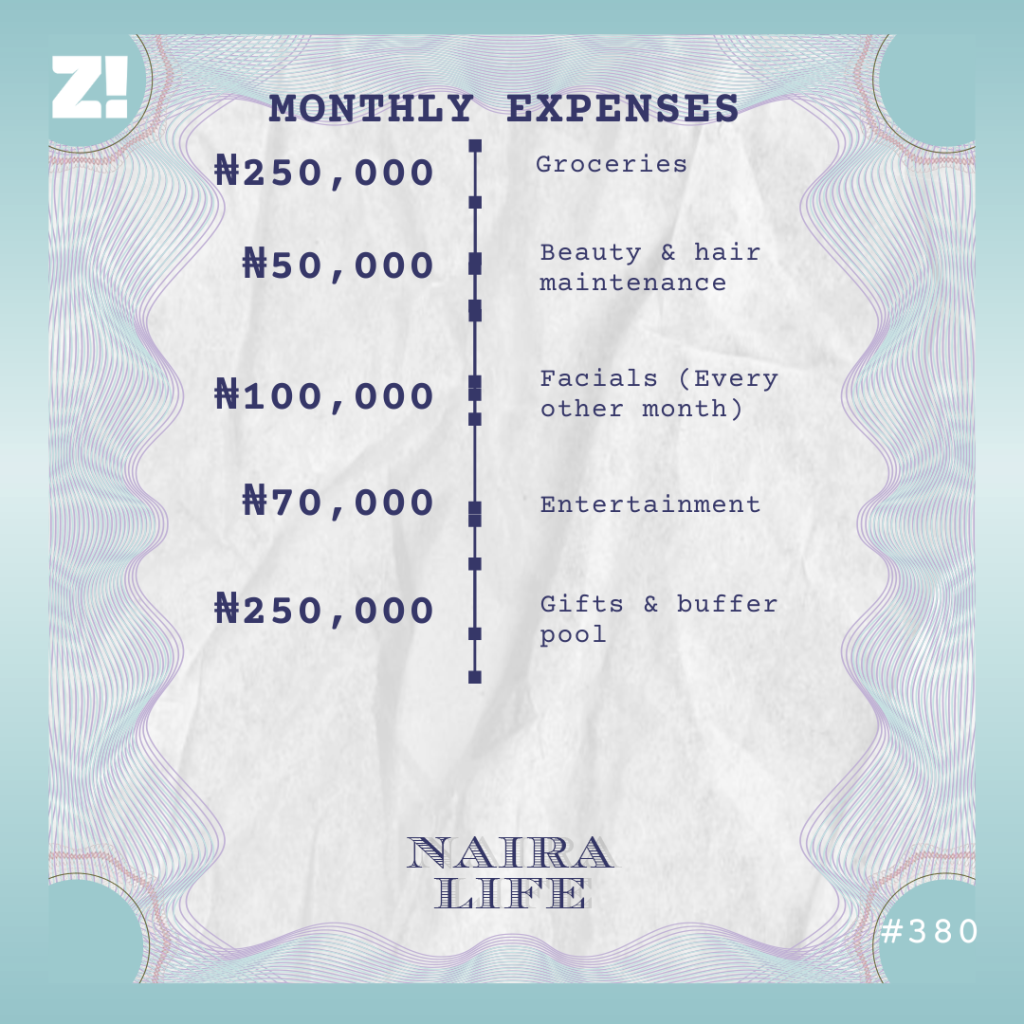
That brings my baseline operational spending to around 鈧�1.5 million a month. Recently, I鈥檝e been trying to be more budget-conscious and more intentional about saving.
What do your savings currently look like?
Right now, it鈥檚 just 鈧�300k. I completely wiped out my savings over the last few months. It was my 31st birthday recently, and because I had never thrown a party for myself, I blew 鈧�2.3 million celebrating. Then in June, my younger sister graduated from university, and I emptied the remaining buffer to give her a substantial cash gift.
But starting this month, my savings strategy is incredibly strict: I am locking away at least 鈧�1.6 million from my salary each month.
I am saving for a major financial milestone. I find Lagos completely unlivable (and overly expensive), so I am planning to move to Abuja permanently next year. Because my sister is staying back, I will be taking on rent and furnishing entirely on my own. Between paying a year’s rent upfront, physically moving my car and belongings up north, and buying basic appliances like air conditioners, the entire move will cost me roughly 鈧�12 million. Every single kobo I save right now is entirely dedicated to that goal.
How would you describe your relationship with money?
It honestly feels deeply embarrassing. I acknowledge my immense privilege, but there鈥檚 an uncomfortable gap between what I feel my hard work should afford me and what it actually buys.
My peer group is constantly planning summer vacations abroad. My stepmum travels to London for routine medical checkups. My younger brother just bought his first house. Meanwhile, I recently had to turn down a weekend trip to Ibadan with friends because a 鈧�60k – 鈧�100k overnight hotel bill simply didn’t fit into my budget. My friend offered to pay, but I was ashamed that I couldn鈥檛 afford that on my own.
I am 31, single, and navigating my future entirely on my own. If I want marriage or children, I need to build a firm financial foundation because I refuse to walk into a partnership empty-handed. It is frustrating that even on a 鈧�3 million salary, I can’t consider a 鈧�500,000 wig or a quick trip abroad without realising it will actively jeopardise my plans to move. There is nothing left to cut from my expenses, so the only solution left is to figure out how to earn more.
Is there an ideal figure you think you should be earning?
I actually don鈥檛 have a number. I don鈥檛 feel the need to be a billionaire, but I want to live a good life without worrying. I need to have more disposable income. My expenses shouldn鈥檛 exceed 30% of my income, but I鈥檓 at 50%, which is really troubling.
How would you rate your financial happiness on a scale of 1-10?
7. Logically, it feels like it should be a 2. But I chose a 7 because I am naturally a very content person and profoundly grateful to God.
I鈥檓 no longer fighting for my survival, scrambling for basic gigs, or panicking about how to keep my head above water. I am financially stable, and I know I have the skills to build wealth. I just need to figure out how to reach the next level without breaking my peace.
If you’re interested in talking about your Naira Life story, this is a good place to start.
Find all the past Naira Life stories聽here.